The Dialog Files
Techno-Oligarchy’s Right-Wing Turn on Europe

The secretive private society Dialog – self-described as “an invite-only community of CEOs, founders, public intellectuals, government leaders, investors, artists, and more” – rarely made headlines until June 2026. The society, co-founded by US technology entrepreneurs and venture capitalists Peter Thiel and Auren Hoffman in 2006, deliberately avoided media coverage and never had a website reporting on its activities – its current website, dialog.org, was only launched in summer 2023.
Since its inception, Dialog has held annual retreats featuring representatives of the technology, business, and political elites, but needless to say no officially available list of participants has ever been published. One rare prominent headline on Dialog appeared in Axios in 2025 – it was reported that the society was considering acquiring a venue outside of Washington DC that would serve as a permanent hub for the society’s meetings. No update on the reported developments has been published so far.
However, in June this year, just two months before Dialog’s planned retreat in a hotel outside Ireland’s capital on 12-16 August, Wired’s investigative journalists reported on the largest Dialog-related leak to date. Building on the disclosures by the Swiss hacktivist maia arson crimew and apparently other sources, Wired analysed the society’s internal records and revealed insights into both the participants of Dialog’s events and the presumed programme of the Ireland retreat.
Backing the view of Dialog as a tech-industry version of the Bilderberg Group, which has been running annual off-the-record meetings of political, business, and academic elites since 1954, the Wired report demonstrated that Dialog indeed could boast of – if its organisers wanted to – the rare concentration of US power: techno-oligarchs and venture capitalists mingling with military command, serving officials, senators, and diplomats.
Although primarily dominated by representatives of the US elites, the leaked list naming participants of the Dialog meetings features a number of prominent EU-based figures such as Kaja Kallas, the EU’s High Representative for Foreign Affairs and Security Policy, and Jens Spahn, the leader of the Union parties’ parliamentary group in the German Bundestag.
Following the scandal caused by the Wired report, the Powerscourt Estate, which owns the Powerscourt Hotel where the Dialog meeting was planned to take place, cancelled the event on 3 July.
“Powerscourt Estate Media Statement 3rd July 2026 -
Following a period of great concern for Powerscourt Estate and on foot of discussions with The Powerscourt Hotel, we are relieved and pleased to announce the Dialog event planned for August at the Powerscourt Hotel has been cancelled.
Powerscourt Estate wish to thank all of those who supported us through this difficult and challenging time. Including our staff, neighbours, friends, supporters and legal team.
Ends”
But even before news of the cancellation broke, the European Commission denied that Kallas would attend the Ireland meeting, while EUobserver reported that she was not a member of Dialog. At the same time, Kallas’ engagement with Dialog seems to predate the 2026 leaks: Axios mentioned that Kallas was a Dialog participant in its 2025 report.
Spahn, on the other hand, defended his engagement with Dialog – he irregularly attended five Dialog retreats since 2018 – saying that it was important for him to exchange ideas with people who disagreed with him, and mentioning that Thiel, the figure most associated with the society, was absent from Dialog’s retreats for years. Nevertheless, Spahn appeared to have withdrawn from Dialog’s 2026 meeting before the Powerscourt Estate officially cancelled the event.
Technically, the 2026 leak of Dialog’s internal documents, although the most significant to date, has not been the first one, and the discussions of Dialog’s retreats in 2012 corroborate Spahn’s observations that Thiel did not attend Dialog’s meetings, at least regularly.
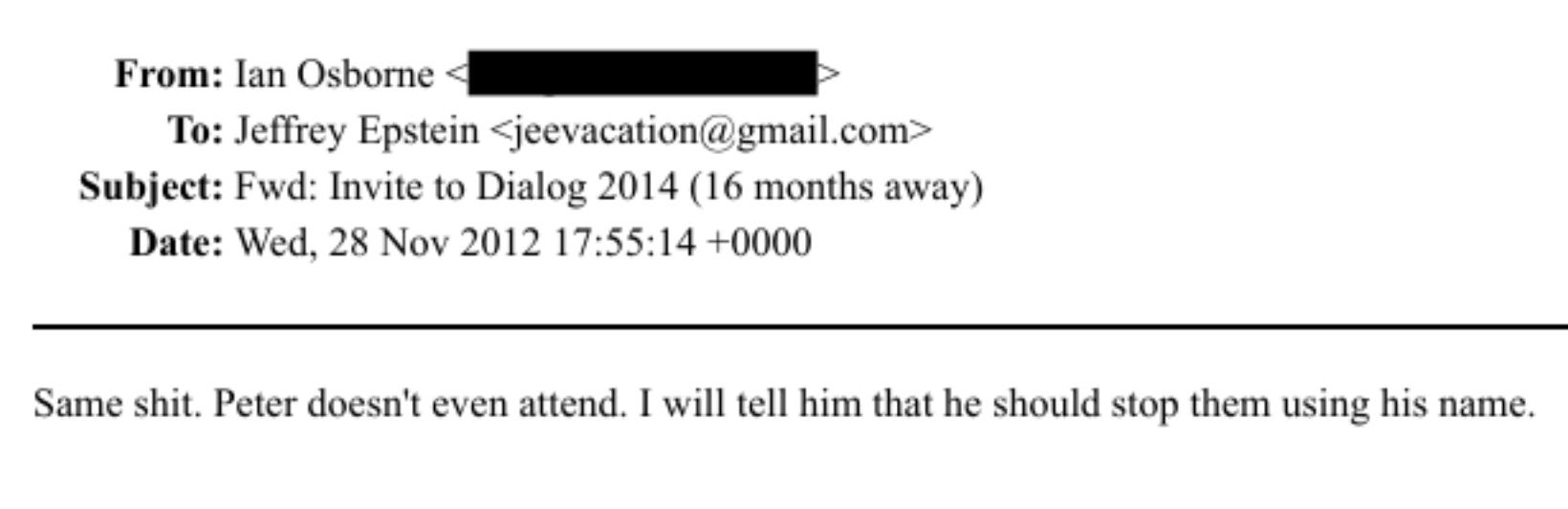
Those discussions were published in the so-called “Epstein files” related to American convicted child sex offender Jeffrey Epstein. In 2012, two contacts of Epstein, Lisa Randall, an American theoretical physicist, and Ian Osborne, described by a Financial Times op-ed as “a fixer to the rich and powerful”, forwarded to him their invitations to attend the 2014 Dialog retreat at Sundance Resort, Utah, sent to them by Auren Hoffman, Dialog’s co-founder. Osborne’s comment to Epstein was that “Peter [Thiel] doesn’t even attend. I will tell him that he should stop them using his name”.
The more revealing part of the Dialog-related “Epstein files” was the list of more than 120 people presumably invited to participate in Dialog’s 2013 retreat. Considering that list, as well as the list of 63 people invited to Dialog 2022, disclosed by one of the invitees, it is possible to trace – despite some obvious limitations like the absence of confirmations of final lists of participants – some trends of Dialog’s retreats from 2013 through 2022 to 2026.
The most visible trend echoes the ideological transition of Silicon Valley from a liberal hub in the early 2010s with a “do-gooder” approach to technological development to the right-wing obsession with using technology primarily for state defence and security, as well as for techno-oligarchic individualist projects (biotech, advanced AI, space exploration). This right-wing turn was reflected in the near-complete disappearance, already by 2022, of Dialog participants who represented progressive civic-tech idealism. The disclaimer, on Dialog’s laconic website, that the society “has no ideological agenda” does not seem to be sincere.
The political context helps explain Dialog’s right-wing turn between 2013 and 2022 too: the far-right businessman Donald Trump was US president between 2017 and 2021, and significantly changed the political landscape of the country.
This context was also reflected in the changes in Dialog’s political roster: representatives of the US conservative movement and Christian right were already present in 2022. The difference, however, between 2022 and 2026 is that the 2022 retreat showed no capture of sitting US state power, while the plans for the 2026 Ireland meeting revealed exactly that, as Scott Bessent (US Secretary of the Treasury), Dan Driscoll (US Secretary of the Army), and Jim Himes (the ranking member of the House Intelligence Committee), to name a few, were shown to be on the Dialog 2026 list. Again, Trump’s return to the White House in 2025 helps explain this development in Dialog’s political preferences.
Yet another visible trend concerns the changes in the non-American engagement with Dialog’s meetings. In 2013, most foreign participants of the society’s meeting represented European intellectual circles, but already in 2022 many non-American participants tended to be functionaries and sitting office-holders. The fact that Jens Spahn apparently attended his first Dialog retreat in 2018 when he was German Minister of Health suggests that by 2022 this trend had already taken shape. Other participants confirming this trend in 2022 include, in particular, Japan’s minister Tarō Kōno, and Harald Mahrer, the then-president of Austria’s Federal Economic Chamber.
Together, these trends demonstrate the radical politicisation of Dialog, its thrust towards techno-oligarchic state capture, and its attempts to infiltrate European policy-making.
The EU has several regulations that represent a major nuisance for the US technology firms, most importantly the Digital Services Act, Digital Markets Act, EU AI Act, and the Markets in Crypto-Assets Regulation. These regulations may impose significant compliance costs and increased financial exposure from potential fines and penalties, and the US technology companies have long been battling – often trying to engage with various European political forces in Brussels – to weaken the EU’s regulations.
The choice of country for the society’s 2026 retreat was thus hardly a coincidence. Ireland is the EU base for most US technology companies which are drawn by the relatively low corporate tax rates. The country also acts as those firms’ main privacy watchdog for the entire EU, because the Union’s rules let a company be policed mainly by the country where it has its EU headquarters. Ireland’s regulator has a long record of going easy on these firms, so the place meant to hold Big Tech accountable across the EU has instead become its shield.
In this sense, Dublin was to become – in addition to Brussels – yet another battleground for the techno-oligarchy’s assault on European regulations and sovereignty.